Tricycle is pleased to offer the Tricycle Talks podcast for free. If you would like to support this offering, please consider donating. Thank you!
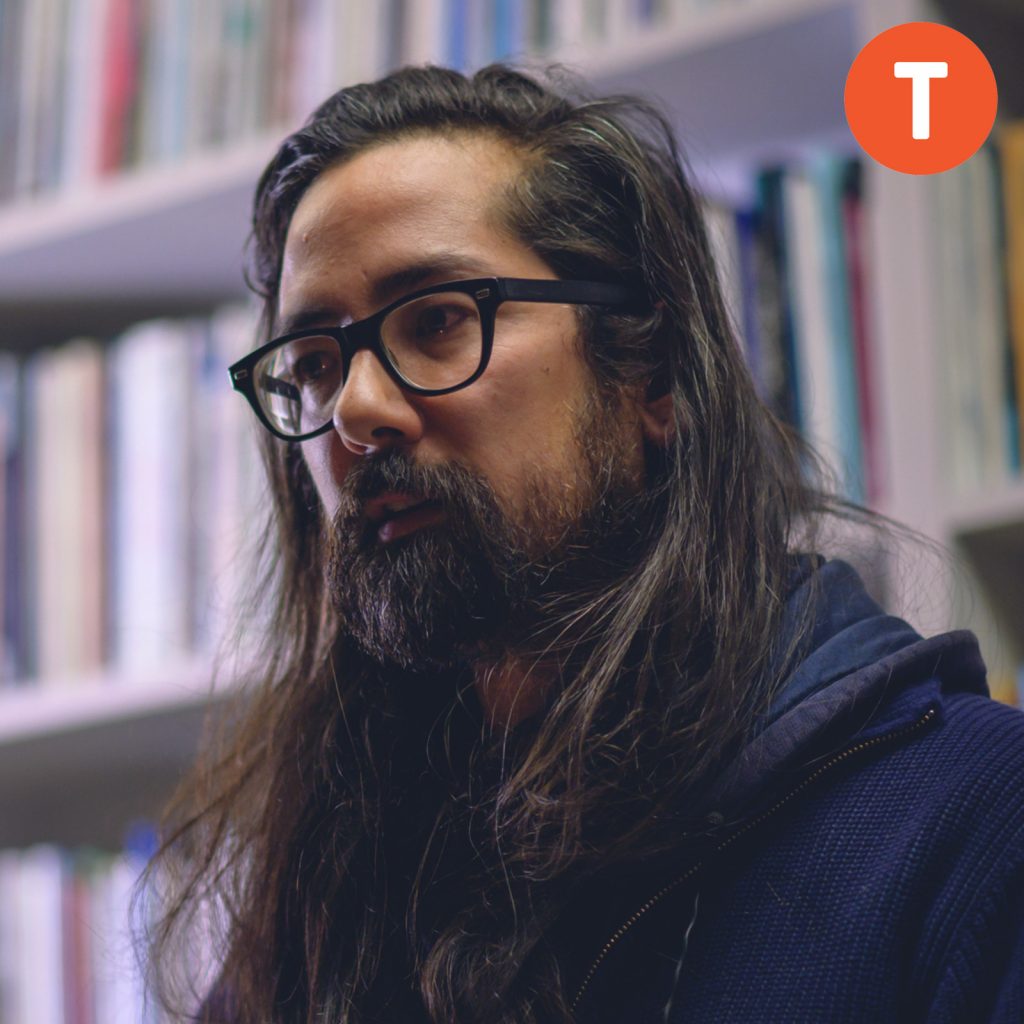
Brandon Shimoda is a poet and a professor at Colorado College. His latest book, The Afterlife Is Letting Go, examines the ongoing legacies of the US government’s mass incarceration of Japanese immigrants and Japanese Americans during World War II. Drawing from years of archival research, visits to the ruins of incarceration sites, interviews with survivors and their descendants, and his own family history, the book explores the resonances between forms of oppression and state violence past and present.
In this episode of Tricycle Talks, Tricycle’s editor-in-chief, James Shaheen, sits down with Shimoda to talk about how he learned about his own family history of wartime incarceration, the question of how to memorialize an event that is still ongoing, the emergence of solidarity movements like Tsuru for Solidarity, and how he views the role of poetry in reckoning with this history.
Read an excerpt from The Afterlife Is Letting Go here.
Tricycle Talks is a podcast series featuring leading voices in the contemporary Buddhist world. You can listen to more Tricycle Talks on Spotify, Apple Podcasts, and iHeartRadio.
♦
We’d love to hear your thoughts about our podcast. Write us at feedback@tricycle.org.
Read transcript
Brandon Shimoda: One of the many things that the anthology process made us realize is that poetry is a consequence of a traumatic experience. In a way, a traumatic experience produces the kind of consciousness and sensibility that produces in turn poetry because why would there be so many who are also poets writing about this? Poetry just seems central to at least my understanding, but certainly it seems like to the understanding of all the people in the anthology, central to how we redress these kinds of wounds. The poetry needs to happen actually for anything to be redressed or anything to be healed. James Shaheen: Hello, and welcome to Tricycle Talks. I’m James Shaheen, and you just heard Brandon Shimoda. Brandon is a poet and a professor at Colorado College. His new book, The Afterlife Is Letting Go, examines the ongoing legacies of the US government’s mass incarceration of Japanese Americans during World War II. Drawing from years of archival research, visits to the ruins of incarceration sites, interviews with survivors and their descendants, and his own family history, the book explores the resonances between forms of oppression and state violence past and present. In my conversation with Brandon, we talk about how he learned about his own family history of wartime incarceration, the question of how to memorialize an event that is still ongoing, how writing the book was a process of pilgrimage, and how he views the role of poetry in reckoning with this history. Plus, Brandon reads an excerpt from the book. So here’s my conversation with Brandon Shimoda. James Shaheen: So I’m here with writer Brandon Shimoda. Hi Brandon. It’s great to be with you. Brandon Shimoda: Hi, James. Great to be with you too. James Shaheen: So Brandon, we’re here to talk about your latest book, The Afterlife Is Letting Go. The book explores the ongoing legacy of the incarceration of Japanese Americans during World War II, and it was many years in the making. So to start, can you tell us a bit about the book and what inspired you to write it? Brandon Shimoda: Sure. Yeah, I think there are many inspirations for it. I think the biggest one is actually growing up not knowing anything about this history, so it was sort of an inspiration in the negative. I had family in camp. My grandfather was not a citizen, so he was in a DOJ prison. But this was history that I didn’t know anything about because nobody in my family talked about it. So I think this book was in the making from a very early age, although I didn’t think of it being a book. I didn’t even know what a book was when I was very young. But I think what was beginning to germinate was this confusion, this frustration, this feeling like something was being withheld or something was missing. And for me, a big part of writing is addressing those kinds of things: things that are withheld, things that are missing. So it was a long process of awakening into an awareness not just of my family’s experience, but of course of the experience of Japanese Americans in general. And I think the only way I could really figure it out was by writing, and then it accumulated over time into what became this book. James Shaheen: So how did you come to learn about your own family history as well as the broader history of Japanese American incarceration? Brandon Shimoda: Yeah, I’ve been trying to remember. I mean, oddly, given how much I’ve written about this, I should know this by now. I don’t know if there was a point or a moment in which this history was presented to me. I think it was something that was presented in fragments over many years. So people in my family would allude to the war. They would allude to camp, they would allude to places like Missoula or Minidoka, they would mention names of things, but there was never any context and there was never any elaboration. I remember when my sister and I were very young, we had an aunt who gave us a book of photographs by Ansel Adams of the Manzanar camp, and I remember that book and I remember what it looked like and I remember the font. I don’t really remember ever opening the book, and I don’t remember there being any conversation from my aunt or anyone else about what the book was. It just kind of sat there, and it wasn’t really, I think, until my freshman year of undergraduate school when I took an Asian American history class and we were reading about incarceration, and I think all of those fragments that were offered to me over time began to clarify in that class. And that was the first time I sat down with my grandmother and interviewed her and asked her direct questions about this history. James Shaheen: Yeah. You also say that one of your earliest encounters with Japanese American incarceration was through the movie The Karate Kid. Can you say something about that? I found that so funny. Not funny, but bizarre, you know? Brandon Shimoda: Yeah. Bizarre. Well, bizarre. I think, yeah, I think that’s a big part of it, is how bizarre to experience this history through a movie like that. I mean, I write about this in the book. Of course, I watched that movie many times. It came out in ’85 or ’86 or so, and I memorized the movie. But there was that one scene where Mr. Miyagi, the old man from Okinawa, gets drunk, and he starts to reveal all these things about his past. His wife was incarcerated in the Manzanar camp, and she gave birth to a child and the child died, and he fought in the 442nd, and all of these things that are discovered through Daniel, through his apprentice. And I remember hating that scene. I mean, it was, I think, in general uncomfortable because you’re watching this man get drunk and he’s passing out and it’s just an uncomfortable scene. Over time, what happened is that I started to forget the rest of the movie except for that scene. So the scene that I hated the most was the one that had the most enduring power. And again, it was a while before I understood not only what that scene was saying, but why I felt so uncomfortable about it, why it was, yeah, distressing, why I was having an almost physical reaction to that scene, because it was telling me something much deeper obviously than the rest of the movie was telling me. But I think that was, certainly in pop culture, the first glimpse into that that I was aware of. James Shaheen: You know, a lot of people might be surprised that you knew so little about it, but I’m not at all because a very close friend of mine who died a few years ago discovered when her mother died a $20,000 payment into her bank account. This was in the nineties that her mother died, and she wanted to find out what that was, like what was this federal government deposit? And she discovered that her mother had been incarcerated only after her mother died. And I think what she said was there was always something unsaid, and she didn’t know what it was. There was always something withheld. There was a kind of silence, and so her mother tried to protect her from the reality of what happened, but that was actually impossible because somehow it was passed along. So can you say something about all that, because, you know, there’s no getting around it. It will surface somehow, even if it’s unspoken. Brandon Shimoda: Right. Yes. And I think if it goes unspoken, it resurfaces in interesting, strange, complicated ways. I think one of those complicated ways is through creative writing, creative work, art. But yeah, one of the things, so it is very common that not only descendants of people who were in camp grow up knowing very little, and by the way, it’s also common that people did grow up knowing a lot. There are just as many families that spoke openly about it, and there are many reasons why some families spoke about it and others didn’t. But there are people who were born in camp who were very young in camp who also in a way didn’t really know because it was never talked about what happened. Not until they were teenagers or in their twenties would they say, “Wait a minute, why was I born in Arizona? Why was I born in Wyoming?” So even people who were there grew up within that space of silence. And, again, there are many reasons. Shame is the one that’s probably most commonly cited. But I think assimilation and the drive both within the JA community and by the government to assimilate this population meant that the more you talk about it, the more you dwell on it, the more difficult it’s going to be for you to assimilate into white culture. And so, you know, that’s somewhat of a generalization, but that I think framed a great deal of how many people responded. And I grew up on the East Coast. I grew up in Connecticut, so there wasn’t a community with which I could process this or think about it. So it was really up to my family. If my family wasn’t talking about it, then I would get it nowhere, whereas people who grew up in California, they had that community. If they weren’t getting it from their family, they could get it from friends and they could kind of collaborate in that way. But yeah, in terms of New England, Connecticut was sort of Japanese American Siberia, in a way. James Shaheen: Yeah. You know, the other side of that is I’m from Southern California. My parents witnessed this all happening, and the question for them was like, well, didn’t anyone do anything? And they were rather silent about that. Brandon Shimoda: Right. Yeah. James Shaheen: You know, and one must ask oneself, what would you do? And today we’re seeing people being picked up by ICE, and will the next generations say, “Why didn’t you do anything?” You know, it’s analogous, I think. Brandon Shimoda: Right. Yes. I mean, it’s interesting, because a lot of our understanding of who we are and how we behave is framed as like a future understanding, looking back. And if that motivates people, that’s great. But yeah, whatever needs to be done in the present, I mean, it certainly was a different time, and it is complicated, and I think there was a level of secrecy, especially when they started rounding up the men after Pearl Harbor prior to the executive order. You know, there were exactly these kinds of raids, but there was no one filming them. There were not people who were standing outside of people’s front doors trying to prevent those FBI agents from coming in. They didn’t know that that was happening. I mean, if you were direct neighbors or things like that, you were somewhat aware. You had somewhat of a hint of what was going on. But yeah, I also do think that there were forms of resistance that were happening, maybe not on a mass scale, whether it was within the JA community or neighbors, but in a way, those stories of resistance were buried initially, I think in order to further this narrative that the JA were complicit and they kind of went into camp. James Shaheen: Well, that was the story, that they were complicit, you know, that was the story. So you open the book with a question from the scholar Christina Sharpe. Her question is, “How do we memorialize an event that is still ongoing?” So how do you think about this question, and how did it serve as a guide for you in writing this book? Brandon Shimoda: Yeah, that’s a huge question. So that’s from Christina. Christina Sharpe is just an incredible thinker, writer, a huge influence on my thinking and writing, and that’s from her book In the Wake: On Blackness and Being, and she’s talking about the afterlife of slavery: How do we memorialize an event that is still ongoing? Thinking about all the ways that slavery, for example, is still manifest, all those different aspects of that social relation manifest in contemporary life, and all of our attempts to kind of put it away via memorialization. And when I read that book and when I read that question, and it’s part of a series of questions that she asks, it was such an instantaneous realization not only of that particular subject but of ways that I could be thinking about Japanese American history or any histories of state violence and trauma incarceration. Because I became really fascinated with memorials, and I was spending a lot of time with memorials and trying to figure out, well, what exactly do these memorials mean if what they are commemorating are things that are still happening? And that could be happening within the JA community, or it could be happening to other communities, like is happening now. What exactly is it we’re memorializing if all of the elements and attributes of that situation still exist? So the book in a way is not even really an attempt to answer that question, but just to kind of hang out inside of that question, to hang out with Christina’s thoughts and her thought process. James Shaheen: So in writing the book, you interviewed a number of survivors and descendants, including some of your own family members, and you also visited the ruins of incarceration sites and many of the museums and monuments in the country. So can you say more about the process of writing the book? In particular, how did you go about interviewing survivors and descendants? Brandon Shimoda: Yeah, that started as a social thing. I was interviewing family members and friends initially not really with the idea in mind that I’d be weaving their words into a book. There are so many elements of this book that were autonomous. You know, I would write about a certain thing or I would be having conversations with somebody, and the book kind of came together later. A lot of it was just interacting with my community and also maybe trying to discover my community. And then it really clarified during the pandemic, because I initially had all these plans to visit all of these sites in 2020–2021, and I received a grant to do that. But of course I found myself at home and I was trying to figure out, well, how can I continue doing this research, putting this book together from home? How can I create a kind of virtual pilgrimage? So I made interviewing and conversations more of a focus, and that’s when it really expanded a lot. So what was initially just me hanging out with people became, OK, this is the way I’m going to find out about this history. And thank goodness. I mean, I don’t thank the pandemic for very much. But it completely transformed the nature of this project from me just being alone in various sites to me being with other people, ironically, given that I was just sitting at my desk in my bedroom. James Shaheen: You know, the book feels very community oriented, almost like creating a community in itself. Can you say something about that? Brandon Shimoda: Well, I love that that’s true, and I think that maybe is, for me, the pivotal revelation of putting this together is starting from a place of deep interiority, not self-centeredness necessarily, but really trying to understand my own experience, and realizing ultimately that I could only do that by surrounding myself with other people who are asking similar questions or who are having similar feelings. So, you know, initially it was a relationship that I was having with my family and my grandfather in particular. But, yeah, I guess as I just said, it’s really the story at the heart of it was that there are many thousands of people who are kind of grappling with the same questions, the same experience, and the revelation being that there was a community. I was already a part of it, but really the story that I was going for was just how we all live with each other, how we all live in general, how we talk about this, how we don’t talk about it. And ultimately I think the book is very communal because that is kind of how it came together. For me, it’s a record of those relationships. When I pick it up and when I look at it, I think about the people that I spend time with and the people that I still spend time with. James Shaheen: You know, you mentioned your grandfather, and a number of your books revolve around attempts to learn more about your grandfather and his experience during the war, and you note that you moved to Missoula in 2004 nominally to start an MFA program but really to be close to your grandfather since that’s where he was incarcerated. So can you tell us about your time in Missoula? Brandon Shimoda: Yeah, it’s true. I mean, a lot of these connections that I was making with my grandfather—and I do feel like I was following in his footsteps in many ways through many locations—were not totally conscious or not entirely intentional. For example, when I moved to Missoula to start an MFA program, I happened to be down the street from where he was imprisoned. I knew that, but I didn’t really know what that meant. And I didn’t really know that that was this unconscious influence on me being there because my entire time in Missoula was just kind of centered around spending time with his memory. And that became very obvious once I was there, but not when I was getting there. So I went through two years of the MFA program, and then I lived there for two years after, and that’s when I started really writing about this history. And I would go to Fort Missoula, I would spend time with that land, I would spend time in the one barrack that remained standing there, I’d spend time with photographs of him that were exhibited in those barracks. And with no real agenda. I mean, I was learning how to be a poet, and I think what that ultimately ended up meaning is listening, absorbing, allowing the questions to unfold in the process of writing poetry itself as opposed to imposing questions on top of the writing. Very simple things. I think poetry ultimately is a very meditative practice. So it’s kind of like four years of meditating in the shadow and in the presence of my grandfather. You know, I’m still trying to figure out why and what exactly is the nature of my relationship with this person who died when I was 18 thirty years ago. I’m still chasing that, but it’s been a gift. I guess I shouldn’t chase it too much. James Shaheen: Yeah. You know, it seems like going to Missoula was almost the unconscious beginning of a very long pilgrimage that culminated in this work, you know? Brandon Shimoda: Yeah, that’s true. Yeah. James Shaheen: The prologue begins with the story of James Hatsuki Wakasa, who was shot and killed while stopping to look at a flower apparently. So can you tell us about Wakasa and the ongoing tensions over the rock that became his monument that memorialized his death? Brandon Shimoda: Yeah. So that’s the prologue, and oddly, it’s the longest chapter in the book, even though it’s the prologue, and it was one of the last things I wrote because to me it embodies really everything I’m trying to say about what the afterlife is. So James Hatsuki Wakasa was an immigrant. He lived in the US for forty years, and he was one of 8,000 people incarcerated in the Topaz camp in Utah. And he was murdered by a teenage military police officer one night as he was walking along the fence, walking a dog that may or may not have been his dog, but he was walking a dog, and he collected stones, and he looked at flowers, and he was shot. And shortly after that there were other Issei, first-generation men, in the camp who erected a monument for him that the government then ordered be destroyed. And this monument was a 2,000-pound stone. And so they quote unquote destroyed it, and seventy-eight years later it was discovered. There was a little piece of the stone that was sticking out of the ground, and it turned out they didn’t destroy it; they buried it. So the tension that you’re mentioning is what happened after that stone was discovered as being still in existence. The local museum, which owns the land, they sort of preemptively removed the stone from the ground and brought it back to the museum. And that’s kind of a Pandora’s box. I mean, the moment the stone came out of the ground, it was like those seventy-eight years of tension and trauma and confusion and grieving, not that they had ever gone away, but they were re-released in a new way. And so it’s very much a question about how do we memorialize, how do we think about the past? And it’s not really tensions between sides; it’s really this very complicated conversation that’s going on about how do we think about this history, and in particular what does the murder of this man tell us about this history that we haven’t been really thinking about? Many people died in camp. Many people were murdered. Most of those stories have not been told. Some of them exist in somewhat of a fog. But I think this stone is sort of bringing with it all of these questions and considerations, hopefully. It’s something that’s still very much going on now, you know, conversations with the museum on what to do with the stone. It’s like this magnetic, electrifying object that is producing all kinds of feelings and behaviors. James Shaheen: You know, the example of this stone feels emblematic in some ways of the struggle over who gets to tell the story and how, because the museum dug up the stone thinking it was preserved, bringing it into a museum and keeping that memorial as a symbol, and who has control over the objects of mourning and memorialization because the Japanese American community wasn’t consulted when they dug this up and dragged it into a museum. Can you say something about that? Brandon Shimoda: That’s a huge question, who gets to. I mean, in a way I feel like the stone gets to tell the story, and it’s really a matter of trying to figure out how to listen and to what. So one of the things I write about, and one of the things I think about is, well, what does the stone have to say? And a lot of people think that that question is maybe a little ridiculous, that the stone is just a stone. But I feel like given the conversations and anguish, et cetera, that the stone has inspired that the stone is very powerful, and I think everybody is able to contribute to a story. I don’t think there’s any one story, but I think it becomes really despairing when people stop listening to each other. And in this case, I think especially listening to survivors and descendants, the people who in a way are the ones who developed this stone and have this particular relationship to the man who was murdered, and therefore to everyone in the camp who mourned him and mourned their own experience. I should say that the museum did consult the Japanese American community initially, as well as archeologists and other people, and a determination was made to keep the stone in the ground. And so what the museum actually did was they defied that professional advice, and there were no JA there, there were no archeologists there when it happened. But yeah, I don’t have a concrete answer on who gets to tell the story because there’s also so many stories. And to me, the question itself about who gets to tell the story and the conflict that produces is a huge part of the story. And I don’t know who gets to tell that, but I feel like everything that happens becomes part of the story. I don’t think we can really hide any of it in the same way that you can’t really hide this 2,000-pound stone. James Shaheen: Yeah. You know, in this book, stones seem to have a lot to say. You know, it begins with the internees collecting stones. And in one chapter that we ran on Tricycle‘s website, you discuss some of the ways people preserved their sense of dignity and humanity in the face of state violence, and you give an example of the Heart Mountain sutra stones, which is quite an extraordinary story. On an earlier podcast with Duncan Ryūken Williams, we talked about that. So can you tell us about that story? Brandon Shimoda: Yeah, and Duncan’s in this chapter actually. Duncan’s in this book a few times. Yeah, it is really interesting because it’s such a humble exercise to be wandering the grounds of your prison picking up stones. In the Heart Mountain sutra stones in particular, there were these stones that were discovered that had they had characters on them that I think once there were a certain number of stones that were amassed, it was determined that the characters were spelling out the Lotus Sutra. And it’s another example of people kind of burrowing into their experience just by grazing the land that they’re on, just picking up things and making art out of them, or, you know, using them to recite a sutra, using them to meditate, making sculptures out of them, making gifts out of them. I mean, there’s the 2,000-pound stone, but we’re talking about pebbles, essentially. And that provided within this really complex experience these moments of very simple connection to oneself and also to the land, to each other. So those stones were discovered, and I write in that chapter, which is also the chapter about Missoula, about the ways that those stones inspired other makers, filmmakers, and poets. James Shaheen: You know, I should say who Duncan is since maybe our listeners don’t know. Duncan Ryūken Williams is a Japanese American scholar who teaches at USC, and he has written plenty about the incarceration of Japanese Americans and immigrants. When I talked with Duncan, he compared the painting of those stones with characters to the Japanese medieval practice of burying sutras in the ground during mappo, or the degenerate age of the dharma. So I wonder how that resonates with your understanding, or is that just too much to ask? Brandon Shimoda: That’s great. Well, I didn’t know that. I mean, that’s so evocative. I don’t know anything about the degenerate age of the dharma. I need to look that up. What does that mean? James Shaheen: It is in medieval Japan, and even among many today, we’re understood to be living in a time when the dharma is in decline, and it will continue to decline over centuries until the next Buddha arrives. Brandon Shimoda: Well, I need to read what Duncan has written about this idea of painting stones and then burying them, and what were some of the intentions behind that, but what I think, because I think I write about this, I make the equation between that and poetry. And the reason why I talk about those stones in relation to Missoula is because I felt like the only way I could communicate with my grandfather was by finding some way to create the sensation for myself that I was being lowered into the earth, that if I could do that, that I could communicate with some part of his experience that I wouldn’t be able to do if I was fully awake and standing on top of the earth. So I think about the practice of inscribing these stones and burying them as a form of communication, and maybe it’s a form of communication with the future, and so, I don’t know, maybe it was also a way for him to communicate with me. It was more intuitive. I wasn’t thinking about it in a programmatic way, but I love the idea of inscribing stones and burying them. To me, that feels like that’s what a poet does, essentially. James Shaheen: Yeah. So you note that Duncan actually asked you to write a poem in a response to another Buddhist priest who collected stones, Nyogen Senzaki. Would you be willing to tell us about Senzaki? And then maybe you can read the poem. Brandon Shimoda: Sure. I know very little about him. I think my relationship to him was activated when Duncan invited me to write a poem about him, and I thought, what a beautiful invitation to write about somebody who I’ve never heard of before. It turned out that he was actually layered into all of these poems that I’d written many years ago, discussions about him and discussions about these stones that would make these kind of random periodic appearances in poems by Japanese Americans about incarceration. So I’m still learning about him, but I spent time with some of the things that Duncan provided me with in order to write this poem. And I think it was a similar sort of thing. Poetry for me, as I said, is not only a meditative act, but it’s a way for me to meditate on other things. So, yeah, my relationship with him began by writing a poem. I didn’t really enter into it with a prior relationship. James Shaheen: Would you be able to read that poem for us? That’s on page 215. Brandon Shimoda: I will try. James Shaheen: To put you on the spot. Brandon Shimoda: Yes. So this poem appears within the book. I think it’s the only poem. I wanted to sneak a poem into the book, and this was the poem, and this was for Duncan, but also for and after Nyogen Senzaki. It’s called “The Empty Hands.” I cannot help but see and yet struggle to see in Nyogen Senzaki’s poems faces floating along the body of a snake black, winding away from the spring flower blooming in America, that is the ritual effacement of those whose faces I cannot help but see in ours, in yours in my own floating along the body of a silent, surreptitious snake like scales, like sequins, shining suns like suns shining into the future with the shades drawn That is where we, the descendants, are and where we will always be Beckoning them with the empty hands of those from whom everything was taken Faces separated from their bodies bodies arrested, separated into phases that constitute what passes for history There is no such thing There is teaching. There is learning There is heaven, earth but history? There is no such thing if the light of a face if the light of many thousands of faces takes generations to reach us and to be seen clearly and to not even be seen, clearly but as a figurative concentration there is no such thing There is teaching, there is learning that is heaven, that is earth that is the endless reconstitution of face into the meaning and the order of independence in between heaven and earth, the empty hands open, and introduce their emptiness as sanctuary but, as the scripture of a harder-won fate will have it, cannot be filled, cannot be taken or even touched by the lives—by the faces rising off the winding body and to which they are held out to which they are conditioning their beneficent and beautiful atmosphere to hold The empty hands must remain empty or they are not James Shaheen: Thank you. So you’ve mentioned how poetry has been central to your own way of relating to this history, and certainly what you just read is an example of that, and you recently edited a poetry collection, The Gate of Memory, which is the first anthology of poetry written by descendants of those who are incarcerated. So I wonder if you could tell us a bit about that collection and the role of poetry in reckoning with this history. Brandon Shimoda: It was a dream that my friend Brynn Saito, who’s also a poet and who had family in camp, it was a dream that we had of making this anthology as a way to bring together a group of poets that we already knew. And it was a small group, but we thought it would be really interesting to see what’s out there and what this work will look like when put into community with itself, with each other. And we ended up compiling 1,000 pages of poetry by descendants, all poets, all writing about incarceration. And we knew that there was a lot out there, but we didn’t know that we would have a thousand pages to go through. I think one of the many things that the anthology process made us realize is that poetry is a consequence of a traumatic experience. In a way, a traumatic experience produces the kind of consciousness and sensibility that produces in turn poetry because why would there be so many who are also poets writing about this? And one of the common things as we talked about at the beginning was this idea of not really knowing the history. And so many of the contributors to the anthology, they’re writing poetry that is also working through these various states of unknowing. And so that also seemed to be where poetry is born. If you combine all of these different qualities of experience, poetry is one of the things that results. And it’s a really beautiful anthology because once you take all of that and put it together, you start to see the way all of these people, Canadians and people in Japan and Hawaiians and Alaska natives who are also incarcerated, by the way, how all of their thought processes are in really surprising correspondence with each other. Poetry just seems central to at least my understanding, but certainly it seems like to the understanding of all the people in the anthology, central to how we redress these kinds of wounds. The poetry needs to happen actually for anything to be redressed or anything to be healed. James Shaheen: You know, a thread that runs through the book is how the incarceration still echoes today. One way is the conversion of former wartime incarceration sites into present day incarceration sites and detention centers. So could you tell us about the parallels you see? ANd how can learning and engaging with this history help us meet various crises we’re facing today? Brandon Shimoda: That is a huge open question, and in my most pessimistic moments, I wonder how knowing our history can prevent things happening in the present, because for a long time, and still there’s this idea, you know, if you do not know your history, you’ll be doomed to repeat it. But it very much seems like if you also know your history, history is doomed to repeat, because the people that are putting into place all of these forms of incarceration and family separation and deportation and so on, they know history very well. It’s not not knowing history that is making this happen. Knowing history is also making this happen. So that’s something I’ve been wrestling with, something I’ve been trying to write through currently. What does it mean and what kind of impact can be had by knowing history, and extensively as well? One way I think about it is this idea of parallels or echoes, but to me it’s all part of a contiguous chain of events. So the things that are, for example, tested out on native populations and reservations can become very useful during JA incarceration. What’s being tested out in JA incarceration becomes very useful for subsequent phases of, to me, something that’s an unbroken series of events as opposed to things that recur. I mean, I think the way that state violence works and the nation states work is by constant experimentation to find the right ways to impose violence on populations. It evolves. It doesn’t go away. It doesn’t even necessarily change. It just kind of evolves, if that makes sense. James Shaheen: Yeah, I mean, I think each case has its specific differences with the cases that proceed it, but you discussed some of the solidarity movements that have emerged, including Tsuru for Solidarity, which was cofounded by Duncan, our friend Duncan again. I mean, one thing I wanted to mention is that Duncan tells this story of after 9/11, a Japanese American woman who had been interned sat in front of a mosque, and the imam or somebody came out and said, “What are you doing here?,” just out of curiosity, and she said, “I just want to make sure what happened to us doesn’t happen to you.” I found that deeply moving. So can you tell us the story behind Tsuru for Solidarity? How did you come to be involved with that? Brandon Shimoda: Yeah, so it’s a Japanese American–led social justice organization, and they have a few different campaigns that they work on: healing justice, Black reparations, ending detention sites. And Duncan would be able to explain the exact origins of it obviously better, but I think it is rooted in what you just described. So after 9/11, and also during the first Trump presidential campaign, when the Muslim ban was invoked, what happened is that many people, many Japanese Americans who were incarcerated started to speak out for the first time, and we’re talking about, you know, seventy-five years later, again, going back to that sort of atmosphere of silence. People were seeing what was happening to other communities or the threats that were being posed on other communities, and that inspired them through their anger and frustration to start talking about their own experience and applying that to the Muslim community, for example. And so Tsuru for Solidarity is sort of an outgrowth of that whole, in a way, personal sea change within individuals. So one of the really defining moments for that community was this protest at Fort Sill, which I write about. Duncan was there. And it was a group of survivors, primarily, who were protesting the proposal to open up the Fort Sill military base as an incarceration site for migrant children from Central America. And so these two worlds are colliding, these people who are in their 70s and 80s standing on the front lines surrounded by military police saying, “We’re not going to let this happen again.” And so I think that was one of many events and experiences that happened, but something clicked: We can use our experience to be in solidarity with people who are suffering the same kinds of injustice now. And it’s beautiful. I mean, the ways I’ve been involved have been somewhat peripheral. I’ve done events for them, and I know many of the people who are involved with that. But what I witness is just something heartbreakingly beautiful, very empowering, people who are drawing from their own trauma to open up a space of possibility in terms of fighting on behalf of other people and then forming alliances with other communities. And so that’s the work they do. I mean, it’s, it’s been, I guess, six or seven years now, really incredible. James Shaheen: You know, we talked earlier about parents who kept from their children that they had been incarcerated, whether it was to protect them or to assimilate or to make it go away, I can’t say, but one aspect of the solidarity work that you mentioned is passing down this history to the next generation, and one of the most touching chapters in the book begins with your reading children’s books about wartime incarceration to your daughter. So how do you think about passing down this history? Brandon Shimoda: I guess there are so many ways that that information could be passed down. I started reading books about incarceration to my daughter when she was probably three months old. I mean, I went in the opposite direction as my father, who didn’t mention it once, and aside from that Ansel Adams book, I don’t think we had any books in our house about this. So I knew that when I was going to have a child, I was going to go in the opposite direction and maybe overwhelm her, inundate her with something that she didn’t want to listen to. But what’s happened is when I was young, there weren’t that many children’s books about this history, and now there are dozens, and they’re not just retelling the story in ways that we’ve already heard. They’re getting into really interesting corners and pockets of that story. And so, yeah, one of my personal projects is I wanted to share all this with her, and I still do. She’s 7 now. I just wanted her to grow up with a foundational understanding of this history, because it’s part of our family’s history, but also as a way to understand what it means to be a citizen of this country. I wanted her to have that foundation, and in a way, I want her to have the freedom of being not indifferent, but of not being confused. I didn’t want her to inherit my confusion of not really knowing exactly the nature of being an American citizen in relationship to all these things that are just so overwhelming, but to have just kind of a basic understanding of, yes, this is what it is. This is what happens. This is what this country does, this is what this country’s capable of. And doing that through children’s books. Initially, she was confused by, I think, the emotions, because I write about when we would read these books together, I would cry, and I was trying to shield her from my emotions, but I also wanted her to see that this was an emotional situation. I don’t know. We’ll see what kind of impact that has. She’s Gosei, she’s fifth generation, and that generation, they’re so savvy. They’re so clever and knowledgeable, and they’re able to make connections between things that took me a lot longer. I’m not representative. I was just a slow learner. There are many people who were not like me, but I’m really happy that the next generation can not move on from this, but move through it in different directions. I find that very inspiring. James Shaheen: You mentioned reading to your daughter, and I think you said something like what it means to be growing up as an American, or in America, and you know, Duncan said something really interesting. As you know, his father’s British, his mother’s Japanese, he grew up in Japan, and he became a Zen priest. You know, people would talk about themselves like, “I’m half this and I’m half that.” And most of us can say something like that. And he said, “I’m wholly both,” you know, whether he’s white or Japanese, he goes, “I’m wholly both.” And he had a different idea of what it meant to be an American where there is no center. Nobody is at the center. It was a very interesting idea, and Duncan’s formulation, “I am wholly both and I’m American,” was a pretty interesting way to see a way through what we seem to be witnessing now, sort of this retrenchment into “This is what it means to be an American,” an idea that never really was true and isn’t true now. But it’s an interesting thing. I grew up saying, “I’m half this and I’m half that,” and it doesn’t really make sense. I don’t know how you can be half anything, you know? Brandon Shimoda: Yeah. Well, it’s certainly imposed from the outside. I mean, I love Duncan and the way he thinks, I think of it as having a hybrid identity, and that to me is like a river. I mean, it’s constantly changing, and it’s always staying the same. Different things are contributing to it. You can’t really put your finger on any one element of it and say that is the river. It’s in constant motion. What I appreciate about having a hybrid identity, as much grief as it’s given me, is that it is something that is in flux and there is no half. I mean, yeah, that form of measurement doesn’t make any sense. It’s like a nebula. James Shaheen: Right. Well, it’s like the fixity of identity is something that Buddhism critiques. You know, we’re challenged to understand that it’s fluid. Brandon Shimoda: Right. James Shaheen: But the half-half thing becomes especially ridiculous, you know? But when he says, “I am wholly both,” I thought that was a kind of a beautiful formulation. Brandon Shimoda: That is beautiful. James Shaheen: And I change, you know. Brandon Shimoda: And it’s totally true. James Shaheen: Yeah. Brandon Shimoda: When someone says, “I’m wholly both,” that is the thing that makes the most sense. James Shaheen: Right. There’s a sort of embrace of it all. I mean, it only came to mind because you mentioned your reading to your young American daughter, and she’s got to understand what it means to be an American growing up with multiple histories, you know? Brandon: Yeah. James Shaheen: So, Brandon, before we close, would you be willing to read a passage from the book, “Rehearsing the Ancestors”? Brandon Shimoda: Yeah. So one of the ways that I interviewed people was via questionnaire, and the questionnaire was asking survivors and descendants about their relationship to this history. Some of the questions were very straightforward, like “Where was your family incarcerated or where were you incarcerated?” But then some of the questions are more speculative, and one question or a series of questions were about ancestors. So what I’m going to read is the second-to-last chapter of the book. It’s called “Rehearsing the Ancestors.” And it starts with the questions that were in the questionnaire, which are, “Where do the ancestors gather? And where do you go to be with them?” “In the morning,” said Sesshu Foster. “When I look in the mirror,” said Satsuki Ina. “In me,” said Masami Okahara Chin. “Within me,” said Emiko Omori. “Always within me,” said Ken Mochizuki. “Within myself,” said Karli Ikeda-Lee “In myself and outside of myself,” said Tiffany Koyama Lane “At my back, beyond my reach, in my body and all around me,” said Casey Hidekawa Lane/Levinski. “Around me all the time,” said Tiffani Koyano. “Hovering around us all the time,” said Tosh Tanaka. “In us,” said Eric Kubota. “Within you,” said Lisa Nori Nishimura Pawin. “I go inside and outside of my mind to visit them,” said Heather Nagami. “Sometimes I talk to them, and when I do, I feel like I’m inside and outside at once.” “Floating around the edges of my consciousness,” said Laura Mariko Cheifetz. “In my imagination,” said Marlene Shigekawa. “In my mind or heart,” said Brittany Arita. “In the hearts and minds of those that think of them and feel their presence,” said Katie Fujiye Nuss Louis. “All my Ancestors are seated in the luminous center, my Heart, my connection to and expression of Heart Fire and Fire of the Universe,” said Mike Ishii. “My luminous center is where I connect to my Ancestors. From my luminous center I ascend to Baihui (100 Ancestors) in my crown and from there to Heaven where they always await me.” “In my blood,” said Sara Onitsuka. “In my mitochondrial DNA,” said Linda Suzu Kawano. “Somewhere up there in the ether,” said Alden Hayashi. “In the air, in the water, the soil,” said Chelsey Oda. “In our earth,” said Esther Honda. “In nature,” said Ellen Bepp. “Where there is nature and stillness,” said Alyssa Watanabe Kapaona. “Where there are stones and gardens,” said Nancy Ukai. “Near a stream,” said Autumn Yamamoto. “In moments of quiet reflection,” said Evan Iwata. “In little moments of noticing,” said Megan Kowta. “My grandparents raised me with the notion that everything is alive in nature, holding a spirit, and where I can commune with my ancestors,” Ellen Bepp continued. “My parents raised me in a house in a valley surrounded by forests and hills,” said Naomi Kubota Lee. “Fog drifted in from the ocean and we had a creek with wandering salamanders. It was a way to get away from it all. It gave them peace. And now I feel that was the point. This is where I visit their souls.” James Shaheen: Thank you so much for reading that, Brandon. Anything before we close? Brandon Shimoda: I don’t think so. I’m really grateful for your questions and the opportunity to think about all of this. James Shaheen: OK, well, Brandon Shimoda, it’s been a great pleasure. Thanks so much for joining. For our listeners, please pick up a copy of The Afterlife Is Letting Go, available now. James Shaheen: You’ve been listening to Tricycle Talks with Brandon Shimoda. To read an excerpt from Brandon’s book, visit tricycle.org. Tricycle is a nonprofit educational organization dedicated to making Buddhist teachings and practices broadly available. We are pleased to offer our podcasts freely. If you would like to support the podcast, please consider subscribing to Tricycle or making a donation at tricycle.org/donate. We’d love to hear your thoughts about the podcast, so write us at feedback@tricycle.org to let us know what you think. If you enjoyed this episode, please consider leaving a review on Apple Podcasts. To keep up with the show, you can follow Tricycle Talks wherever you listen to podcasts. Tricycle Talks is produced by Sarah Fleming and the Podglomerate. I’m James Shaheen, editor-in-chief of Tricycle: The Buddhist Review. Thanks for listening!

Thank you for subscribing to Tricycle! As a nonprofit, we depend on readers like you to keep Buddhist teachings and practices widely available.